Skip to the story
Acts & Chapters
01 / The living idea

Co-benefits  ·  Prologue

One purpose.
Many consequences.

Carbon capture is the purpose.

But living systems rarely do only one thing. When carbon becomes biomass, it can begin to repair the systems around it.

Cooler cities
Cleaner air
Living habitats
Healthier water
Restored soils
Resilient fields
02 / The living city

Act I  ·  The living city  ·  Chapter 1

Cities were built
to shelter us.

Their surfaces now trap the heat around us.

Urban heat is not a distant climate abstraction. It is produced and stored by the surfaces around us.

The phenomenon

Urban Heat
Island Effect

Concrete, asphalt and rooftops absorb and retain heat, intensifying local surface temperatures.

A question of surfaces

What if the same surfaces could instead help to moderate the heat?

03  ·  A second skin for the city

Not a new city.

What if the surfaces heating our cities became surfaces that cooled them?

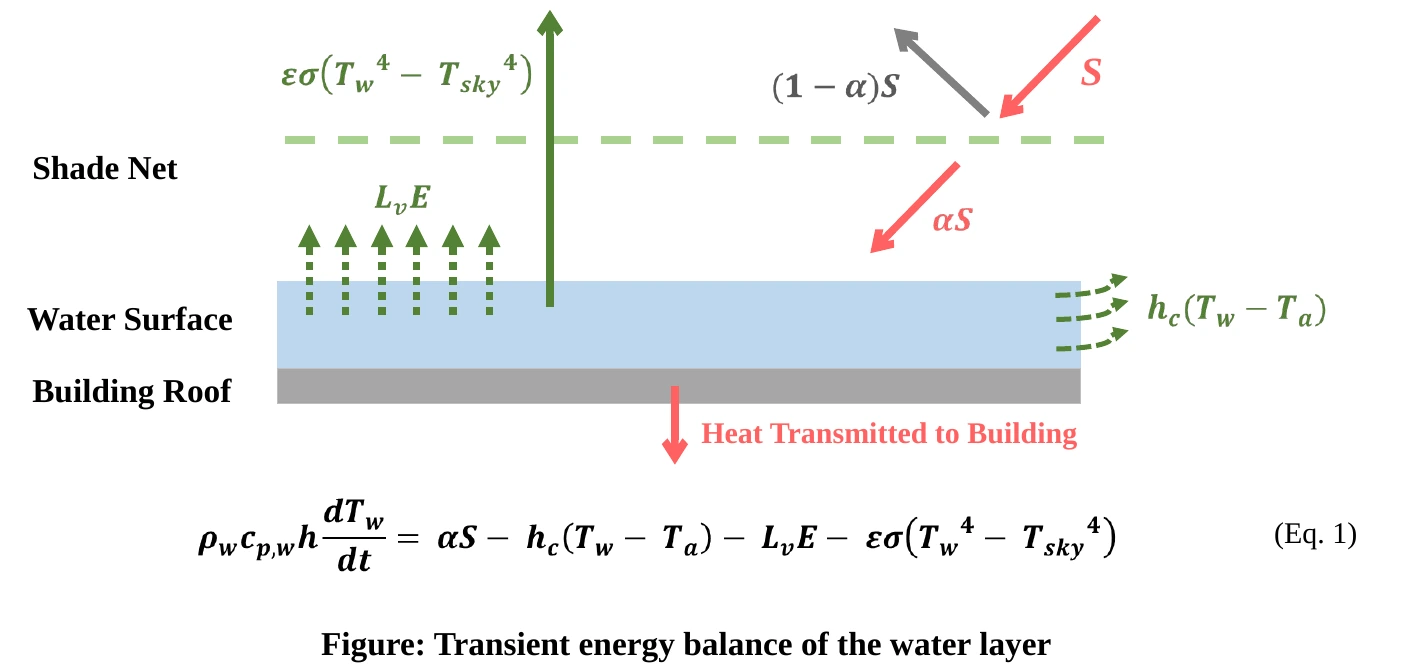
An ordinary roof becomes a shallow water body. The added thermal mass reduces the range of roof-temperature fluctuation; Azolla then spreads across the surface, and the same logic can fold down into wall channels.

40–120 W/m²Less peak downward heat flux · modelled
15–35 kWhₑ/m²·yrAvoided cooling electricity · modelled

Physics-based New Delhi rooftop model · SBEET research · not observed field performance

SBEET 2026 thermodynamic energy balance of the rooftop water layer, including Eq. 1 showing absorbed radiation, convection, evaporation and long-wave radiation
Rooftop thermal energy balance · Eq. 1 · SBEET 2026, Basak, Anwer & Mishra · modelled, not measured field performance.

03 · Roof, water, fern and wall

A legible section, not to scale

Roof. Water. Fern. Wall.

The roof remains. A contained shallow water layer moderates temperature fluctuation; a living Azolla layer occupies the water surface. Wall channels are a proposed extension.

0.01–0.5°CModelled local UHI mitigation signal; depends on coverage and urban form.
AZOLLA COVERLiving biological layerSHALLOW WATERContained thermal mass · modelledEXISTING ROOFStructural support · illustrativeWALL CHANNELSConcept under investigation

Conceptual explanatory diagram. Engineering feasibility, structural loading, waterproofing and biological cooling effects require site-specific assessment and validation.

Act I · Chapter 1 · Thermodynamic modelling

What the rooftop model actually found.

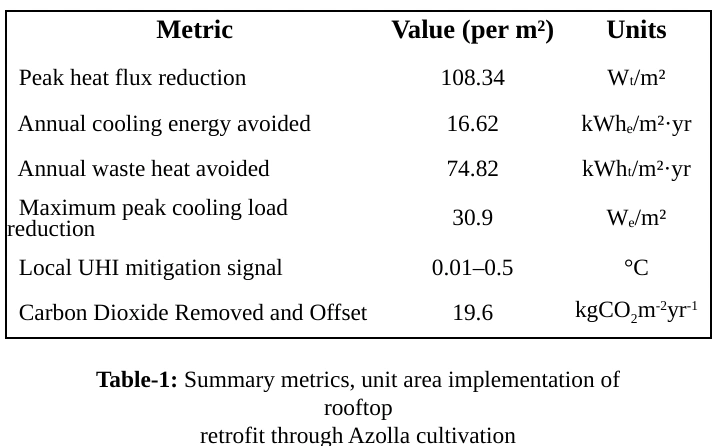
Original SBEET 2026 results table: peak heat flux reduction 108.34 watts per square metre; 16.62 kilowatt hours cooling energy avoided, 74.82 kilowatt hours waste heat avoided, 30.9 watts peak cooling load reduction, 0.01 to 0.5 degrees Celsius local UHI signal, and 19.6 kilograms of carbon dioxide removed and offset per square metre per year
Table 1 · Original presentation results
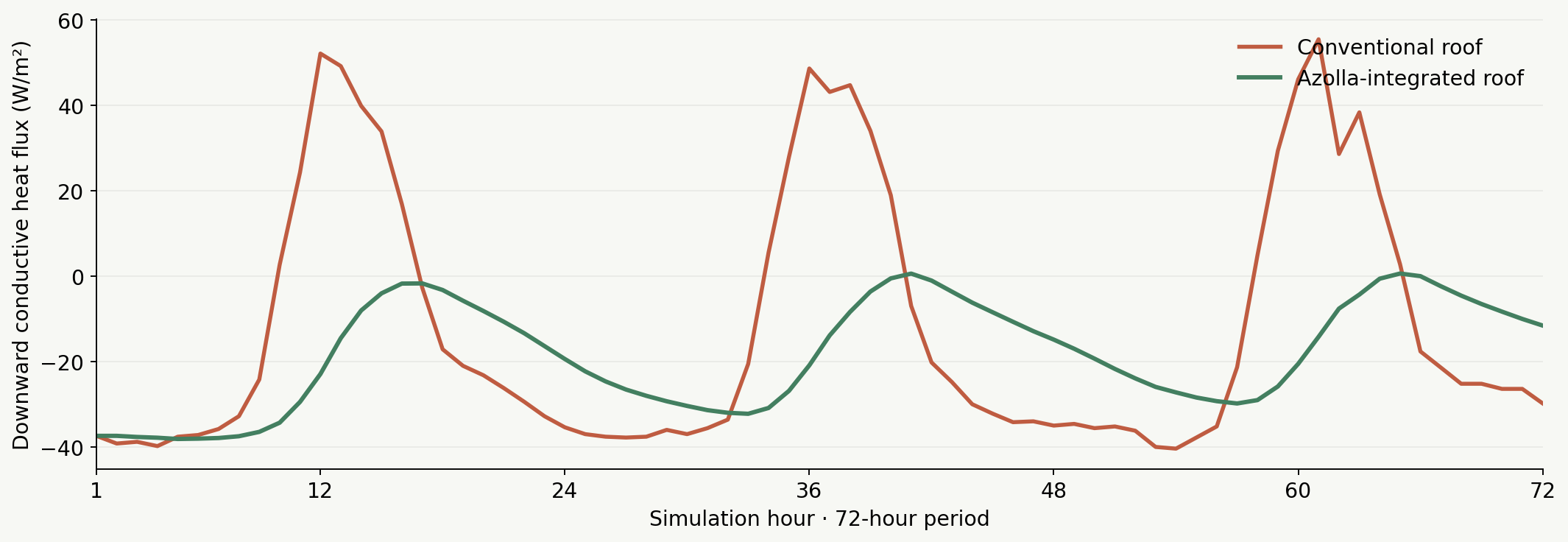
The actual 72-hour modelled heat-flux series from the supplied PowerPoint, comparing conventional roof and Azolla-integrated roof, showing reduced peaks and delayed heat flow
Figure 5 · Original 72-hour series, redrawn for legibility

Source: SBEET 2026 rooftop thermodynamic modelling study. These are simulations, not verified urban-scale field outcomes.

03 · Six-stage proposition and evidence

From a bare roof to a living surface

Sequence · Conceptual / not to scale
15–35 kWhₑ/m²/year
25–60 kWhₜ/m²/year

Range graphics from the SBEET New Delhi physics-based simulation; bar length is illustrative within each metric, not an observed time series.

01Existing roof

The built surface already exists.

02Shallow water

Add a contained water layer.

03Thermal mass

Moderate roof-temperature fluctuation.

04Azolla cover

Cultivation over the water surface.

05Wall channels

Extend the approach vertically.

06Urban replication

Investigate wider applicability.

Modelled

Thermal moderation from the shallow water layer.

Under investigation

Additional cooling from Azolla, evapotranspiration and biological cover.

Chapter 2 · Before pollution becomes air

In Delhi, air pollution is no longer an occasional emergency.

It has become a season.

97 µg/m³Delhi annual average PM₂.₅ · 2025
198 µg/m³Delhi annual average PM₁₀ · 2025

7.9m

deaths attributable to air pollution worldwide · 2023 (State of Global Air 2025)

At the political nerve centre of the world’s largest democracy, the atmosphere itself becomes a public-health emergency.

The air enters everyone.
The protection does not.

State of Global Air 2025 · global mortality context; CAQM / MoEFCC 2025 Delhi annual particulate figures.

ACT I · CHAPTER 02 · OBSERVATIONAL EVIDENCE

What the site measurements indicate.

At a 700 m² Azolla cultivation site in Sector 135, Noida, 84 paired test–control readings showed lower reported pollution indicators within the Azonian site.

18 January–17 February 2026 · paired percentage differences · preliminary manuscript

Mean relative difference from ambient
AQI
51.9%95% CI 49.3–54.5%
PM₂.₅
54.7%95% CI 51.7–57.6%
PM₁₀
61.6%95% CI 58.9–64.3%

Source: EHP Full Paper, Table 2 and Figure 4 (project research manuscript). Comparison is observational and site-specific; enclosure conditions, meteorology and other confounders have not been isolated. Not a claim of equivalent city-wide reduction or proven Azolla-only causation.

The strategic reversal

The sky is the last place to fight pollution.

Stop it before it becomes air.

Dust is not born in the sky.

It begins where land is left exposed. Trace the particles backwards to the places that generate them.

Road dust

Suspended material accumulates along transport corridors.

Resuspended road and soil dust is a leading, recurring source of PM₁₀—and a material contributor to PM₂.₅. The intervention begins with the emitting surface.

05 · Before pollution becomes air

Trace the particles back to their sources.

Construction and stockpiles

Disturbed soil and material handling create localised sources.

Combustion and waste burning

Not every source is dust: combustion sources and waste burning remain part of the source-side picture.

Dry margins and demolition grounds

The emitting surface often exists before the airborne plume.

Primary pathway · land-use change

Change the land that releases the dust.

At strategically selected sources, an exposed landscape becomes a contained, water-covered Azonian site. Where conditions permit, that same footprint can rise into several cultivation levels: one emitting surface replaced by multiple productive biological surfaces.

Dust-producing exposed ground
01 · Dust-emitting surfaceDry exposed ground is repeatedly disturbed and resuspended.
Contained water-covered surface
02 · Contained water surfaceThe exposed substrate is covered: the primary dust pathway is suppressed.
Living Azolla cultivation surface
03 · Living productionAzolla cultivation and harvest turn the footprint into a potentially carbon-removing biological surface.

Interception remains a second line of defence for particles that still reach the system. Prevention, cleaner fuels, industrial controls and transport policy remain essential.

A renewable interception surface · hypothesis

Tree canopy

Trees remain indispensable. A leaf acting as a dust magnet progressively accumulates deposited material; its available interception surface may weaken until wind or rain removes that burden.

A tree canopy waits to be washed.

Azonian surface

Tiny fronds float on water and biomass is harvested frequently. Deposited dust may be removed with the crop, while regrowth continually supplies new contact surfaces.

An Azonian surface can be harvested and renewed by design.

07 · Limitations, harvest cycle and conclusion

This is expressly a field-validation hypothesis—not a claim that Azolla replaces trees or that every frond outperforms every leaf. Biomass exposed to hazardous contaminants must be tested and routed safely.

Interception→wet retention→harvest→controlled removal→regrowth

Source suppression below. Microclimatic repair around it.

A city cannot filter its way out of unlimited pollution. But it can stop treating the atmosphere as the first line of defence.

Act I · Chapter 3 · Observed biodiversity

The city begins alive.

Cities do not lose biodiversity all at once. They lose it one ordinary absence at a time.

A sparrow on a wire. A finch at a ledge. A pollinator or ladybird by a flower. A frog or snail by a water edge. Then familiar lives fade from ordinary places, one by one.

What disappears does not leave an empty space.It leaves a silence.

Original Azonian project photographs · Supplied by project team · Not stock imagery or AI-generated photographs

The possibility of urban habitat

Nature did not have to be invited twice.

Water, shelter, humidity and living biomass appear. An insect arrives. A pollinator rests. A bird approaches the water. A frog emerges. A snail appears beneath the vegetation.

Where water, shelter, humidity and living biomass appeared, other life followed.

The best climate infrastructure may not merely occupy less habitat. It may create some.

Original Azonian project photographs · Supplied by project team · Not stock imagery or AI-generated photographs · The photographs document presence; systematic population-change attribution would require longitudinal surveys.

Transition · Act II · Nothing wasted

A city is not a collection of buildings.

It is a
metabolism.

Chapter 4 · Water does not become waste after one use

What the city rejects does not disappear.

It arrives somewhere else.

Fresh water→use→wastewater→river→wetland→coast
Green nutrient pathway

Tested biomass for productive reuse where water and material are suitable.

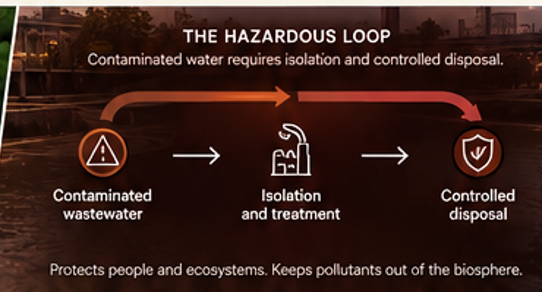
Hazardous pathway

Contaminated biomass isolated and routed towards controlled management.

Beyond nutrient uptake, Azolla has literature-supported potential to accumulate or immobilise certain heavy metals. Effectiveness depends on the contaminant and conditions; contaminated biomass must be tested and safely managed.

The Azonian intervention

Wastewater → treatment → Azolla → harvested biomass → reclaimed water.

The green loop

For appropriately treated, nutrient-rich, non-hazardous water: nutrients enter Azolla; tested biomass enters productive reuse.

ACT II · CHAPTER 04 · WASTEWATER REMEDIATION

Two loops. Two different responsibilities.

The nature of the water determines the fate of its harvested biomass.

Approved artwork: green nutrient loop suitable wastewater to Azolla cultivation to biomass and clean water; red hazardous loop contaminated wastewater to isolation and treatment to controlled disposal
The nutrient loop, original approved artworkThe hazardous loop, original approved artwork

Biological uptake or immobilisation of metals is contaminant- and site-specific; it must not be equated with universally proven inertisation.

Some waste streams contain resources. Others contain hazards.

A circular system must know the difference.

Waste becomes a resource only when responsibility follows it.

Chapter 5 · The nitrogen age

For more than a hundred years, humanity has relied on one dominant answer to the nitrogen problem.

Take nitrogen from the air.
Force it through heat and pressure.
Send it to the soil.

The hidden cost

When energy fractures, fertiliser follows.

When fertiliser fractures, food follows.

We solved scarcity by creating excess.

The nitrogen reached the field. Too much of it kept moving.

Excess nitrogenleaches from fields
Riversreceive the surplus
Algal bloomsconsume oxygen
Coastsinherit dead zones
Planetary boundarybiogeochemical flows
Nitrogen and phosphorus: both planetary boundaries transgressed.Stockholm Resilience Centre / Planetary Health Check. Reactive nutrient surpluses move beyond fields into water, soil and air.

Chapter 6 · The nitrogen inside a leaf

Several superficially similar floating plants may occupy the same visual category. The search matters: Azolla is isolated only after comparison.

On the surface, it is a floating fern.

Inside, it carries something far rarer.

Atmospheric nitrogen moves—not towards a root, factory or external reactor—but into leaf cavities inhabited by Azolla’s inherited cyanobacterial partner.

Industrial fixation

Factory · high pressure · high temperature · fossil energy · manufactured input.

Azolla fixation

Frond · biological partnership · sunlight and metabolism · living energy · self-replicating biomass.

azo– · /ˈeɪ.zəʊ/ · from French azote — nitrogen · combining form associated with nitrogen

AZO7NNitrogenIAN

The nitrogen was in the name all along.

Not a name placed upon the fern. A name drawn from what the fern can do.

Atmospheric nitrogen → Azolla biomass → soil → crop

Not more nitrogen. Better-cycled nitrogen.

ACT II · CHAPTER 06 · MODELLING

The fertiliser connection, quantified.

A literature-based scenario analysis combines assumed annual carbon uptake in harvested Azolla biomass with possible avoidance of urea-manufacturing emissions.

Illustrative outcome per m² of cultivation per year

Gross modelled capture + avoided manufacture (kg CO₂e/m²/year)
45% N loss
8.80Base assumption
55% N loss
9.05Sensitivity case
70% N loss
9.73Sensitivity case

Source: Internal company literature, Table 3, literature-derived modelling. Results are gross scenario estimates, not independently verified net removals. Carbon fate, actual substitution, lifecycle emissions and permanence require field validation; avoided fertiliser emissions are distinct from carbon removal.

The atmosphere held the nutrient. The fern knew how to reach it.

Act III · Returning fertility · Chapter 7

40%

of the world’s land is already degraded

3.2b

people are affected by land degradation

UNCCD global context.

The degradation loop

▥01 · Cover is lostBare soil exposed
☀02 · Water leavesHeat, evaporation and drying
≋03 · Soil movesWind and water erosion
◌04 · Biology declinesLoss of roots and soil life

Wet Azolla mulch

The first act of restoration is not growth.

It is protection.

The mulch shades the surface, moderates temperature, reduces direct evaporation and begins decomposing—helping to change the conditions that drove life away.

Not the conquest of deserts.

The reclamation of land that degradation has made desert-like.

Chapter 8 · Helping the landscape become itself again

Restoration does not begin when the first tree is planted.

It begins when the soil can sustain life again.

When water staysmoisture remains longer
When roots can entera seed germinates
When biology returnssoil aggregates form
When the ground changesit stops behaving like a wound

Ecological succession · no instant miracle

  1. ProtectMulch · shade · moisture
  2. ReawakenMicrobes · fungi · pioneers
  3. EstablishRoots · infiltration · litter
  4. SustainThe ecosystem appropriate to place

Azolla does not need to become the landscape.

It may help the landscape become itself again.

Grassland where grassland belongs. Shrubland where shrubland belongs. Forest only where forest belongs. Natural desert left intact.

The mulch disappears. The conditions it helped create remain.

20 · The ecosystem appropriate to place

Forest where forest belongs
Grassland and shrubland where appropriate
Intact natural desert left undisturbed

Chapter 9 · What we return, we do not own

We know how to count carbon.

Measure it.
Verify it.
Register it.
Trade it.

The act of restraint

Measure what we claim.
Verify what we sell.
Leave the rest unclaimed.

Some Azolla carbon enters soil. Some feeds microorganisms. Some supports roots. Some returns to the atmosphere. Some becomes part of a larger cycle that no registry can completely own.

Not every benefit must be converted into an artefact of the digital realm.

Not every good must become a credit.

Conservatism in claiming

This is not indifference to evidence. Carbon that is commercially asserted remains rigorously measured. It is conservatism in claiming.

22 · Beyond the accounting boundary

Return the biomass. Let the carbon have many futures.

Return the biomass

The biomass is returned without asking the landscape to account for everything that follows.

Let the carbon have more than one future.

The carbon may become soil. Or root. Or leaf. Or shelter. Or the beginning of a forest we will never own. Some also feeds microorganisms; some returns to the atmosphere.

Some things are better left unclaimed.

Some things are simply gifts to humanity.

The reward of not claiming everything

The same restraint that creates fewer credits can create credits worth believing.

The landscape continues capturing carbon after the crediting boundary has ended. Conservative accounting does not diminish planetary value; it clarifies which part can credibly become a commercial claim.

The scale problem

A tonne of biomass can find a use.

A million tonnes can find an industry.

But a gigatonne needs a planet-sized destination.

Carbon problemBiomass is produced
Land problemBiomass assists restoration
Ecological responseRestoration enables uptake
System integrityNo new disposal burden

At planetary scale, waste is not an inconvenience. It is a design failure.

The end becomes another beginning.

Act IV · The field that changes the scale · Chapter 10

The grain humanity carries.

When the world must feed many people—simply, quickly and reliably—this grain is rarely far away.

It crosses borders. Survives governments. Outlasts wars.

It arrives after floods. Waits through drought. Moves through kitchens, relief camps, rations and seed stores.

For billions, civilisation is served one bowl at a time.

The heroic landscape

No single civilisation built it.

No single generation sustains it.

Humanity
does.

Actual documentary photograph of Azolla in flooded rice paddies by Retdar, 2015; Wikimedia Commons CC BY-SA 4.0

27 · One rises. One spreads.

Chapter 11 · The fern beside the grain

Rice rises from the water.

Something else was already suited to the space between: shallow water, sunlight, warmth, nutrients, managed cultivation and seasonal human attention.

Azolla spreads below.

One rises. One spreads.

Two crops. One field.

The crop that sustains humanity and the fern proposed as climate infrastructure are biologically comfortable in the same landscape.

Documentary rice–Azolla field photograph: Retdar / Wikimedia Commons, CC BY-SA 4.0. Not Azonian project media. Photo and licence.

The field acquires new functions

Nutrients

Atmospheric nitrogen enters the frond. Synthetic fertiliser use can contract. Biomass returns to soil.

Ecology

Soil organic matter can rise over repeated cycles. Weed light is obstructed. The water surface becomes less accessible to some mosquito species.

Resilience

Greenhouse-gas pathways respond to management. Farmers move inoculum between local nurseries and fields.

28 · Resilience from the field

The field still produces rice. It begins producing resilience as well.

From field to nation

One farmer’s nursery becomes a village nursery. One village becomes a district. Districts become a national network.

What begins as farmer autonomy can become national resilience.

The fern does not ask humanity to abandon the crop that feeds it.

It asks to grow beside it.

Finale · The surface was here all along

A comparison that changes the question.

VillageDistrictBasinCountryContinentPlanet
≈1.73 million km²Approximate annual global rice harvested area in the original comparison. Farmland already cultivated at continental scale.Area harvested, not continuously available physical acreage; statistic used as an illustrative order-of-magnitude comparison.

Village → District

What begins as a local cultivation surface repeats.

River basin → Country

The agricultural landscape becomes infrastructural scale.

Continent → Planet

The question changes when the existing cultivated surface is finally visible as a global system.

FINALE · THE AZONIAN TARGET

A planetary ambition, now given an area.

At the illustrative working assumption of 7.7 kg CO₂ captured in annual Azolla biomass per m², the proposed deployment horizon requires a biological surface on a planetary scale.

1.5m km²Azonian target cultivation surface
≈
1.73m km²Global annual rice harvested area (approximate)

The scale of the ambition is already visible in the fields humanity tends.

Finale · Putting the area in perspective

1.5 million square kilometres.

A planetary ambition, but not a planetary burden.

16%of the Sahara Desert
20%of the Amazon rainforest

The target is vast. The fraction of the planet required is smaller than the imagination suggests.

Illustrative area-equivalence comparison: neither the Sahara nor the Amazon is proposed as a cultivation location.

We thought we had to build the surface.

We already
farm it.

The question transforms

Where could planetary-scale biological cultivation possibly happen?

How much of the world we already tend can do more?

The water exists.

The biology exists.

The fields exist.

The people exist.

The surface was here all along.

The fastest route to planetary scale may not be to build an entirely new world—but to add new biological functions to the world humanity already sustains.

Visual composition of expansive rice-growing landscapes; illustrative concept artwork, not a geographic crop-area measurement.

The destination is not distant because the planet lacks room.

It is distant because the right systems have not yet been assembled.

The Eocene Project exists to assemble them.

Co-Benefits · Iteration 06 · Visual integration preview