Sources
Atmospheric CO₂, light, water and prepared nutrients enter a cultivated biological environment. Symbiotic nitrogen fixation supports growth.
NEERVANA NETZERO / THE TECHNOLOGY
A living system. Six climate pathways.
An architecture shaped by the Sun.
A brief prologue
This is not the story of one tower or one cultivation bed. It is the architecture of a biological process: inputs, growth, harvesting, transformed materials and the climate effects that may follow. The physical embodiments come later. First, understand the cycle.
Act I / The mechanism
Where every flow has a purpose
A climate process is not defined by what it grows. It is defined by what enters, what leaves — and what happens next.
AZONIAN / SYSTEMS ATLAS
The AzoNian Process connects biological cultivation to inputs, harvested material, circular nutrient flows and multiple possible climate outcomes. Follow the moving lines: the system is more than the sum of its components.
Atmospheric carbon becomes biomass through photosynthesis. Nitrogen-fixing symbionts support growth. Water provides the living medium; carefully prepared organic nutrients replenish other requirements.
Controlled growth is followed by selective harvesting. Residual biomass remains to regenerate the productive surface. Water circulation and environmental management maintain the conditions required by the fern.
The biomass does not disappear once it leaves the cultivation tank. It becomes a material stream with distinct possible uses — and a distinct carbon fate for each use.
The patent's investigated route is biofertiliser and compost. Suitable downstream agricultural use may replace a portion of synthetic fertiliser and support soil amendment or landscape restoration.
Animal feed and biofuel are alternative biomass uses. Their carbon is often returned to the active carbon cycle: the climate case here generally lies in substitution benefits, not automatically in durable sequestration.
Construction carbon, waste diversion, biological fixation, fertiliser substitution, field emissions and restored landscapes. Each must be tested against its own boundary and counterfactual.
Enter the six pathways ↗SWIPE THE DIAGRAM HORIZONTALLY TO EXPLORE ↔
Atmospheric CO₂, light, water and prepared nutrients enter a cultivated biological environment. Symbiotic nitrogen fixation supports growth.
Biomass grows, is selectively harvested and regenerates under managed conditions.
Harvested Azolla may become biofertiliser or follow alternative end-use routes, such as animal feed or biofuel.
The resulting changes in manufacturing, disposal, soil and land-use outcomes need separate scientific accounting.
Chapter 02 / THE LIVING ENGINE
Azolla fixes atmospheric carbon into new biomass as it grows. Its nitrogen-fixing cyanobacterial symbiosis is valuable — but not a substitute for managing phosphorus, water chemistry, temperature, shade or contamination.
Growth · harvest · regrowth
The culture is not consumed by one harvest. Selected mature biomass leaves; the remaining mat provides the beginning of the next growth cycle.
Scientific nuance: biomass productivity, harvest yield and net atmospheric removal are different measurements.
Chapter 03 / THE CULTIVATION PROTOCOL
The patent goes far beyond growing a water fern. It specifies initial inoculation, nutrient preparation, pH and dissolved-solid monitoring, water movement, sediment management, acclimatisation, careful frond agitation and harvesting according to bedding density.
The proposed nutrient route uses aerobically decomposed ripe banana peels, taking advantage of the fern's nitrogen-fixing symbiosis while supplying other nutrients. These are described operating methods, not a claim that the system requires no inputs or no energy.
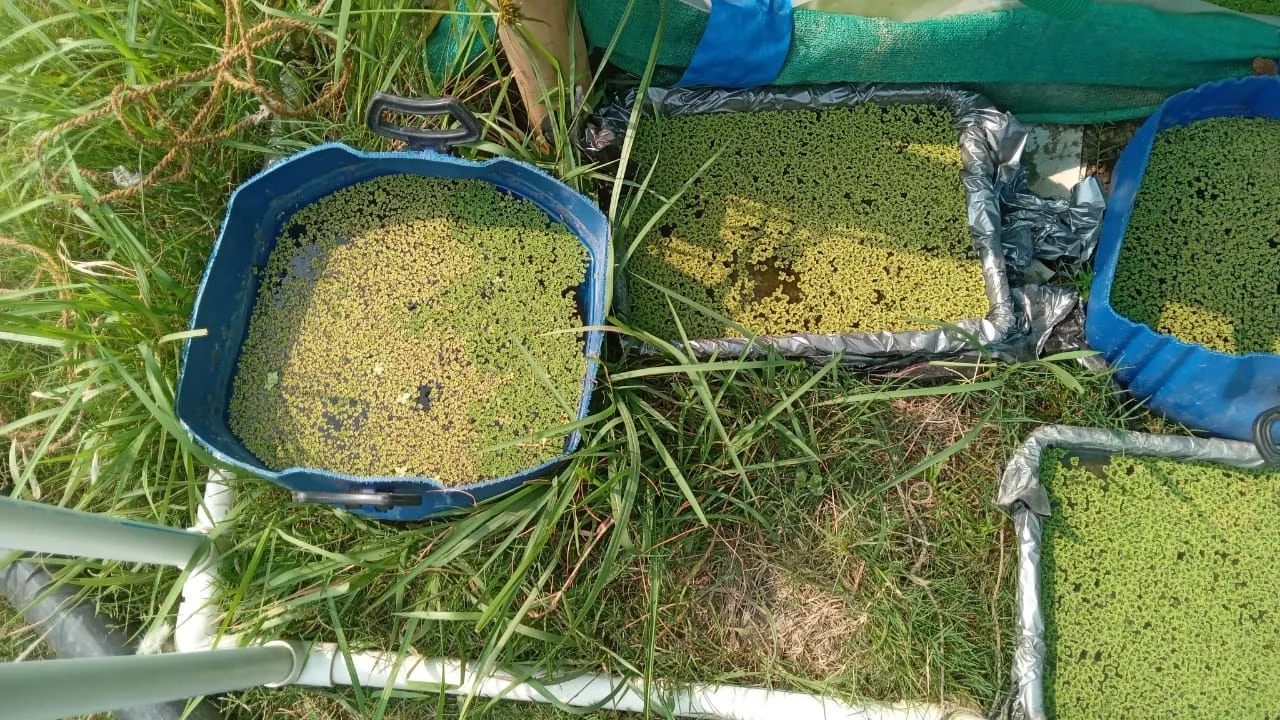
PROJECT PHOTOGRAPHY · EARLY CULTIVATION WORK
Water, soil micronutrients, organic nutrient solution.
Water chemistry, shade, circulation and acclimatisation.
Monitor productive surface coverage and plant health.
Remove mature biomass while retaining regrowth potential.
A crucial distinction
Water, nutrients, structural materials and energy have associated origins and impacts.
Plant growth moves atmospheric carbon into organic material that can be directly measured.
Each downstream use determines whether carbon persists, returns to air or displaces another source of emissions.
Act II / The consequences
The six-level climate pathway · L01—L30
Carbon can be fixed. Carbon can be stored. Emissions can be avoided. The questions — and the evidence — are different.
The source specification groups six mechanisms across Levels 0–3. They are six climate pathways, not six physical storeys or six automatically certifiable removal credits.
PATHWAY 01 / L01 / MATERIAL STORAGE
Plant-based structural materials such as properly sourced bamboo hold biogenic carbon during their service life. Where the actual design uses such materials, a climate assessment must account for sourcing, treatment, transport, fabrication, replacement and end of life.
The first question is not how fast it grows.
For how long will the construction material retain its carbon — and what did its production emit?
TYPE · STORED BIOGENIC CARBON / LIFE-CYCLE COMPARISONPATHWAY 02 / L02 / AVOIDED EMISSIONS
Organic waste can release methane when it decomposes anaerobically in landfill conditions. Diverting appropriate streams into prepared cultivation nutrients could avoid part of that baseline emission — subject to the actual alternative treatment, processing and transport.
Two futures for the same material
Conceptual alternatives. No fixed avoidance factor is assumed.
PATHWAY 03 / L10 / BIOLOGICAL FIXATION
Through photosynthesis, Azolla incorporates carbon derived from atmospheric CO₂ into new biomass. A repeated growth–harvest–regrowth cycle creates a recurring stream of captured biomass carbon, provided productivity is maintained.
The gross biomass ledger
CO₂ from the atmosphere → carbon in dry matter
CO₂ fixed = dry biomass × carbon fraction × 44/12
Converting atomic carbon mass to molecular CO₂ mass. Site-specific biomass composition must be established empirically.
The mathematics beneath the harvest
The earlier Neervana research methodology used a dry-to-fresh mass ratio of 0.07 and an assumed dry-biomass carbon content of 42%. Under those study-specific assumptions, one kilogram of fresh harvested biomass contains carbon corresponding to approximately 0.108 kilograms of CO₂.
1 × 0.07 (dry fraction) × 0.42 (carbon fraction) × 44/12 (molar-mass ratio). An estimate of gross fixed carbon, not durable CDR.
The source specification uses a working productivity model of 71.36 kg fresh biomass/m²/year, corresponding to about 7.7 kg CO₂/m²/year under those same assumptions. This is a modelled reference value, not a universal tower performance result.
Illustrative biological growth curve, not a fitted experimental time series. The research describes an early exponential regime and a later growth regime approaching standing-crop conditions.

EARLIER PROJECT RESEARCH VISUALISATION · HISTORICAL SOURCE MATERIAL
PATHWAY 04 / L21 / AVOIDED MANUFACTURING
Conventional nitrogen fertilisers require industrial manufacture. Appropriate application of Azolla-derived biofertiliser may substitute a portion of their nutrient function, avoiding some associated production emissions.
Two production chains / one agronomic function
Avoided emissions are measured against what genuinely changes — not against an assumed tonne-for-tonne replacement.
TYPE · COUNTERFACTUAL LIFE-CYCLE EMISSIONSPATHWAY 05 / L22 / FIELD GHG OUTCOMES
Once biomass or fertiliser enters agricultural soil, microbial processes can generate or consume greenhouse gases. Changes in synthetic nitrogen inputs, water management and organic-carbon additions can influence N₂O and CH₄ emissions.
The outcome is not always a reduction. Published Azolla field trials report condition-dependent results, including cases of increased N₂O emissions. We should investigate this pathway, not declare a universal outcome.
More nitrogen does not mean less emissions
Diagram denotes possible fluxes, not predicted reductions.
PATHWAY 06 / L30 / LAND CARBON STOCKS
Suitable organic amendments may improve a degraded landscape's ability to support vegetation and retain organic matter. Where restoration produces additional carbon stocks, the change can potentially be quantified in biomass and soils.
Additionality, the baseline, persistence, leakage and monitoring matter. A visibly greener landscape is not, by itself, a measured increase in durable carbon storage.
The question extends across time

ILLUSTRATIVE LANDSCAPE · NOT EVIDENCE OF A SPECIFIC PROJECT RESTORATION OUTCOME
The synthesis / one network, six accounts
Not every kilogram of biomass carbon is stored forever. Not every substituted input guarantees a reduction. Each pathway has a different mechanism, time horizon and evidentiary burden.
How long is the carbon held in construction?
What emissions would the waste have generated otherwise?
How much biomass carbon was actually produced?
What synthetic fertiliser production was genuinely displaced?
Did downstream CH₄ and N₂O emissions change?
Was additional carbon stored, and for how long?
These pathways are not automatically additive carbon-removal credits. Any full-life-cycle result must handle shared baselines, counterfactuals, overlapping effects, energy and materials, and carbon fate.
Between possibility and proof
Harvest logs, calibrated mass measurements, dry-matter samples, carbon analysis and downstream records form the starting point. Lifecycle assessment and credible additionality and permanence methods determine what can ultimately be reported as net climate impact.
The historical presentation envisaged a record-linked AzoNian MRV layer. We distinguish that vision from demonstrated instrumentation, independent verification and issued credits.
A chain of evidence
Harvest mass, productive area and carbon fraction.
Origin, timing, transport and biomass destination.
Baseline emissions and actual downstream outcomes.
Lifecycle, uncertainty, durability and independent audit.
Act III / The invention
The physical limit
Biology occupies surface. Surface occupies land. Unless geometry can make the same ground carry more life.
Chapter 01 / the constraint
A biological system depends on productive photosynthetic surface. Horizontal expansion increases land demand. The patented approach asks a different question: can multiple cultivated surfaces share a compact footprint while retaining suitable environmental conditions?
FROM GROUND TO GROWTH SURFACE
A single cultivation plane has a direct relationship between footprint and active surface area.
Diagram demonstrates geometry, not a guaranteed net productivity multiplier. Lighting, spacing, access and maintenance constrain useful growing area.
Chapter 02 / the sun's changing position
One cultivated level casts shadow upon another. The amount, direction and duration of that shadow change with solar position. Azolla also benefits from moderated illumination and an appropriate thermal environment — not necessarily the greatest possible exposure to unfiltered sunlight.
The invention uses passive solar geometry to relate inter-level spacing to the breadth of the meta-structure and the solar zenith angle at the chosen location.
SCHEMATIC · EXPLANATORY SOLAR PATHS, NOT A SITE-SPECIFIC SHADING SIMULATION
Chapter 03 / passive solar mathematics
The complete specification expresses the local solar zenith angle using latitude (φ), declination (δ) and hour angle (ω), and then relates a selected zenith-angle condition to structural breadth W and vertical inter-level spacing H.
Relationship stated in patent paragraph [0029]. In the limiting case the patent writes H = W tan θz,max.
THE ACTUAL SOLAR POSITION EQUATION
The site's position north or south of the equator.
The seasonally changing angle of the Sun relative to the equator.
The changing position of the Sun during the day.
Angle between the local vertical and the Sun's direction.
Engineering qualification: the patent's maximum-angle condition must be interpreted for a defined design solar window and structure orientation; angles near the horizon cannot simply be used as unrestricted universal maxima. No site-specific tower dimension is calculated on this page.
Chapter 04 / the disclosed meta-structure
The patent describes multiple equidistant levels accommodating paired carbon capture tanks, vertical and horizontal overflow pipes, an access separation and a controlled growth environment. It also describes shaded façades and electrically powered operational components.
The patented example is a technical embodiment, not a specification of every eventual Neervana product. The architectural configurations under development belong on the separate Our Products page.

PROJECT ARCHIVE · EARLY ENGINEERING CONCEPT
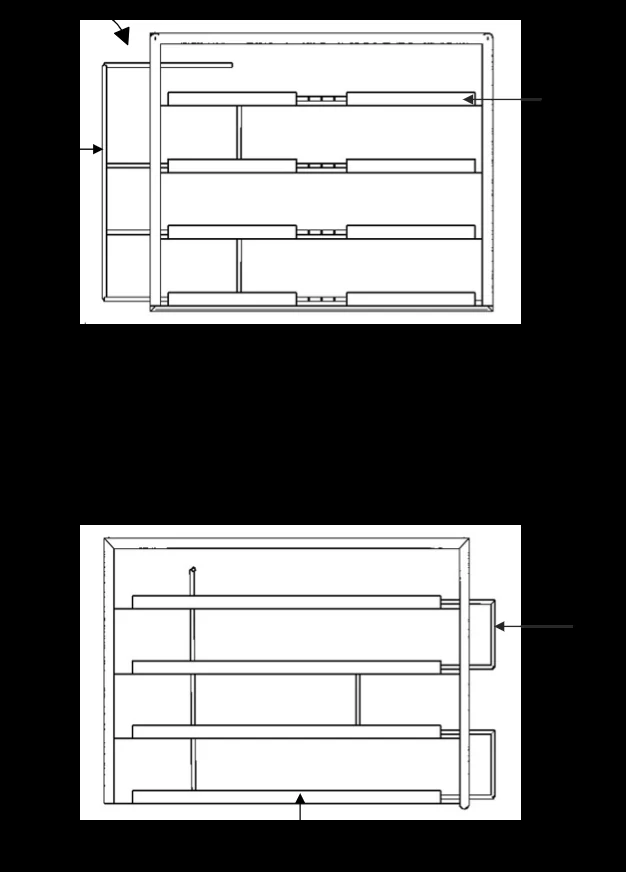
REPRODUCED TECHNICAL DRAWING FROM THE SUPPLIED COMPLETE SPECIFICATION
Chapter 05 / water circulation
The patent's four-level example connects paired tanks horizontally and neighbouring levels vertically, using the water-flow initiator to return water from the lowest level to the uppermost. It describes the exact path: CCT11 → CCT41 → CCT42 → CCT32 → CCT31 → CCT21 → CCT22 → CCT12 → CCT11.
Water movement, aeration and periodic circulation can help regulate conditions; pumps and aerators still have energy demand, which must be counted in the lifecycle assessment.
SCHEMATIC OF THE PATENT'S PAIRED-TANK HYDRAULIC CIRCUIT · NOT A CONSTRUCTION DRAWING
Chapter 06 / the microclimate
The patent describes shading orientations, adjustable façade coverage, sensors for air and water temperature and pH, and a controller that can operate pumps, fans, aerators and sprinklers. It also discloses photovoltaic power for DC loads.
These components do different jobs. Passive solar layout shapes incoming radiation; shading modulates exposure; active systems respond to conditions inside the cultivation environment.
Environmental conditions / response
Spacing and orientation respond to sun position.
Circulation, aeration and solution management.
Air and water temperature, humidity and pH.
Scheduled or sensor-informed operational responses.
These are features disclosed in the published application, not a claim that every product embodiment incorporates each component or that all automated functions have been independently validated.
The original technology / its present embodiments
An indoor stacked unit, an outdoor shelf, a wall-integrated growing surface and a monumental Climate Tower need not look alike. Their common questions remain: usable growing surface, solar access, water management, biological productivity, harvest logistics and accounting.
Here, we have explained the process and the patent's disclosed system. The next page will explore how those principles may manifest as products.
Return to the central idea ↓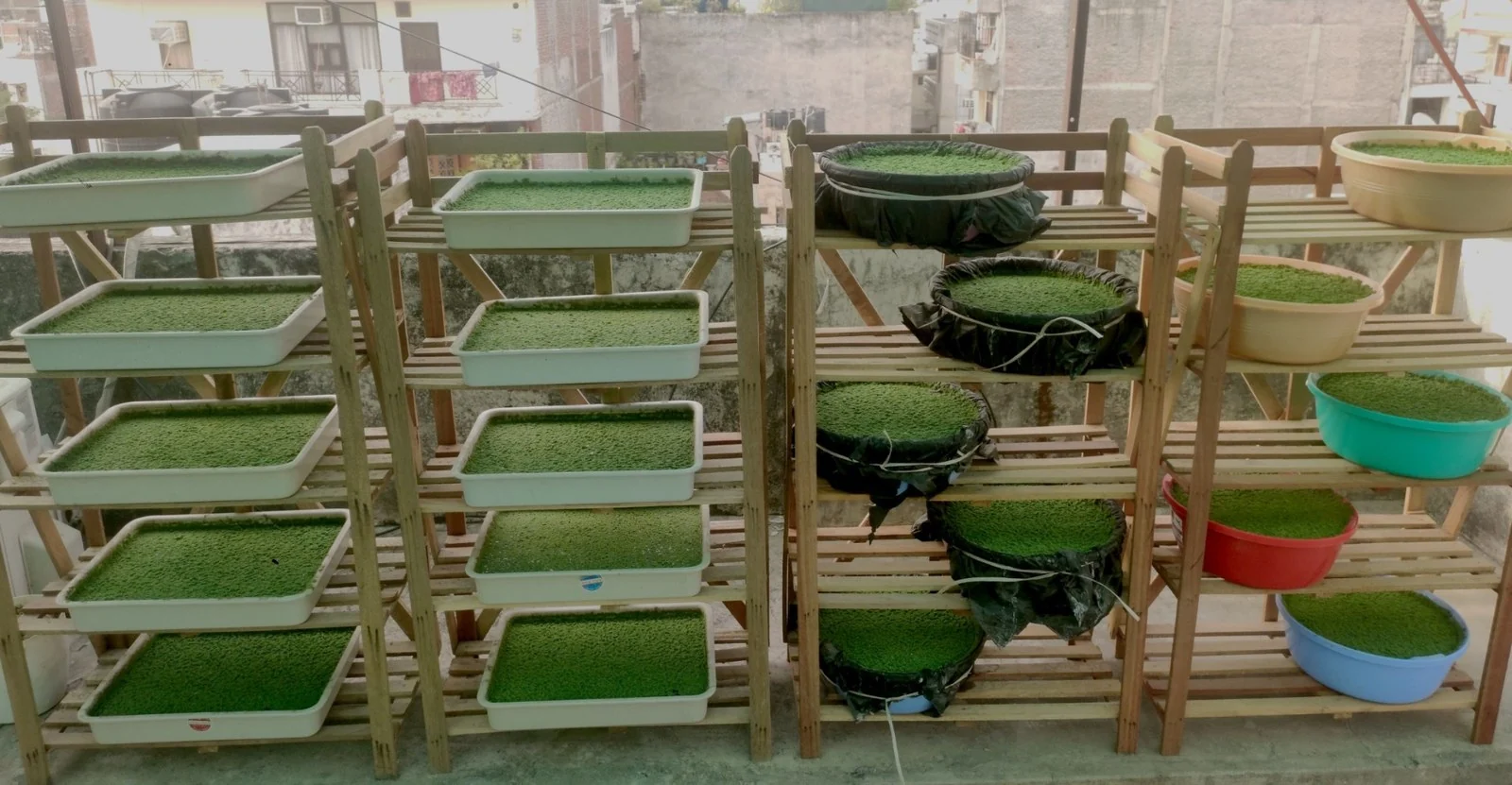
ACTUAL EARLY CULTIVATION STRUCTURE · PROJECT PHOTOGRAPHY
The photograph shows historical experimentation, not a representation of the final approved Climate Tower architecture.
Epilogue / By design
The AzoNian Process is an attempt to turn the familiar physics of photosynthesis into an organised, measurable and potentially scalable climate intervention.
THE SCIENTIFIC RECORD
This page is grounded in the AzoNian patent complete specification, accompanying drawings, the Climate Investment Challenge process schematic, the TERI SAS proposal, and selected peer-reviewed and institutional sources. Hyperlinks open the public original source.
Evidence language is deliberately conditional where work remains modelled, proposed or unverified. Historical photographs are archival project material; conceptual diagrams are not engineering drawings or proofs of deployment.