Neervana NetZero presents

The
Eocene Project

Earth changed its climate once.
We believe it can be done again.

A planetary carbon-removal mission inspired by Earth's climatic past and engineered for its future.

For two centuries,
we have been changing Earth's
climate in one direction.

The question now is whether
we can change its direction again.

The carbon predicament

Cutting emissions is no longer the whole equation.

THE SCALE OF THE PROBLEM

~40 Gt

Annual anthropogenic CO₂ emissions

one annual flow
into the carbon problem

CO₂ emitted by human activity each year — the continuing annual flow into the carbon problem.

~2,500 Gt

Cumulative anthropogenic CO₂ emissions since the industrial era

Cumulative anthropogenic CO₂ emitted since the dawn of the industrial era — the legacy stock behind today's climate challenge.

One hexagon ≈ one present-day annual flow. The historical legacy is roughly sixty times larger.

visual grammar adapted from Neervana's carbon-capture rationale infographic

GIGATONNES.

Climate change is measured in gigatonnes.
Its solutions eventually have to be, too.

Removing carbon is possible.
Scaling carbon removal is the problem.

ENERGY

LAND

WATER

MATERIALS

COST

INFRASTRUCTURE

PERMANENCE

TIME

Existing negative-emissions pathways each offer important possibilities. But deployment at planetary scale encounters combinations of physical, economic and ecological constraints.

We began somewhere else.
Not with a technology. With a question.

Has Earth ever removed carbon at this scale before?

A journey back in time
Today
Present day
A familiar icehouse Earth. The starting point of the journey.
Small shifts accumulate. Continents, circulation and climate keep changing.
The planet becomes progressively less familiar as we move deeper through geological time.
Long-term cooling unwinds in reverse. Warmer climates return.
The great Antarctic ice sheet has not yet defined the planet as it does today.
A greenhouse Earth approaches. High latitudes are far warmer than the Arctic we know.
A warmer Earth. A different Arctic. An extraordinary biological event.
~17°C

illustrative global mean
temperature trajectory

TODAY
5 MILLION
YEARS AGO
15 MILLION
YEARS AGO
25 MILLION
YEARS AGO
35 MILLION
YEARS AGO
45 MILLION
YEARS AGO
48–49 MILLION
YEARS AGO
~49 million years ago · visual reconstruction

THE EOCENE

A warmer Earth. A different Arctic. Across freshened Arctic surface waters, vast populations of a tiny floating fern repeatedly proliferated. Under unusual basin conditions, part of that organic carbon was buried in sediments.

900–3500 GtC

reconstructed potential Arctic carbon storage during the Azolla interval

~800,000
years

estimated duration of the Azolla-rich interval

Published reconstructions, not direct measurements. The magnitude and climatic role of Azolla remain subjects of scientific study.

~49 MILLION YEARS AGO · VISUAL RECONSTRUCTION

THE EOCENE

A warmer Earth. A different Arctic. Across freshened Arctic surface waters, vast populations of a tiny floating fern repeatedly proliferated. Under unusual basin conditions, part of that organic carbon was buried in sediments.

900–3500 GtC

reconstructed potential Arctic carbon storage during the Azolla interval

~800,000

estimated duration of the Azolla-rich interval

Published reconstructions, not direct measurements. The magnitude and climatic role of Azolla remain subjects of scientific study.

THE GEOLOGICAL RECORD REMEMBERS AN EXTRAORDINARY INTERVAL

Its name was
Azolla.

One of the smallest protagonists in Earth's climate history.

The image-led macro transition and scroll choreography will be layered onto this native structure after the draft is validated.

THE EOCENE PROJECT

The first time,
no human was here to witness it.

Forty-nine million years later,
we are asking whether history can be made to rhyme.

Not by accident.
By design.

Not by recreating the Eocene. By engineering the conditions for biological carbon capture to scale—and turning a chapter of Earth’s climatic past into infrastructure for its future.

The next movement begins with the fern ↓

MEET AZOLLA

Small enough to hold in your hand.
Fast enough to make scale conceivable.

A floating aquatic fern measured in centimetres. Photosynthetic. Rapidly reproducing. Working in partnership with nitrogen-fixing cyanobacteria.

MACRO VISUAL · AZOLLA
01 · PHOTOSYNTHESIS

Carbon becomes plant.

Azolla fixes atmospheric carbon through photosynthesis, turning CO₂ into living biomass.

02 · GROWTH

It grows.

Under favourable conditions, its biological surface can reproduce rapidly. The capture medium is alive.

03 · PROPAGATION

It multiplies itself.

The material required for expansion is not manufactured in a factory. New biomass emerges from existing biomass.

04 · AQUATIC CULTIVATION

It lives on water.

Azolla can create photosynthetically active surface without conventional agricultural soil. That does not eliminate nutrient, water or operating requirements — but it changes the geometry of the problem.

Carbon from air.
Light from the sun.
Biomass that multiplies itself.

FOR CARBON CAPTURE, THAT COMBINATION IS DIFFICULT TO IGNORE.
THE PROBLEM OF AREA

Biology was not the problem.
Area was.

Every biological capture system needs productive surface. At planetary scale, the surface requirement becomes an infrastructure problem.

1 m²productive surface

What if the same footprint
could create more surface?

So we built upwards.

↑
THE TECHNOLOGICAL SYSTEM
The AzoNian Process

A proprietary system for cultivating Azolla vertically under controlled conditions — multiplying biologically productive surface within a compact footprint.

We are not trying to invent photosynthesis.
We are trying to engineer its scale.

1
Cultivate
2
Circulate
3
Control
4
Grow
5
Harvest
6
Measure
7
Transform

Atmospheric CO₂ → biological fixation → biomass → harvest → carbon fate. Gross biological fixation is not automatically equivalent to durable carbon removal; downstream carbon fate matters.

THE PHYSICAL EMBODIMENT

The Climate Tower

Biological carbon capture,
made vertical.

The Climate Tower is a new architectural typology for high-density biological carbon capture: a controlled vertical habitat where cultivation, circulation, access, harvesting and measurement become one integrated system.

CONCEPT VISUALISATION · SYSTEM ARCHITECTURE
01
Cultivation levels
02
Water circulation
03
Environmental control
04
Access & harvesting
05
Monitoring & sensors
06
Architectural envelope
07
MRV interface
01
Cultivation levels
02
Water circulation
03
Environmental control
04
Access & harvesting
REPLICATION

The Climate Tower is not a monument.
It is a unit of replication.

One footprint becomes one installation. One installation can become a network.

A DISTRIBUTED CLIMATE INFRASTRUCTURE

Architecture multiplies area.
Biology multiplies biomass.

THE NEXT QUESTION

An idea this ambitious deserves
a simple question.

Does it actually work?

BEFORE THERE WAS A CLIMATE TOWER

We started small.

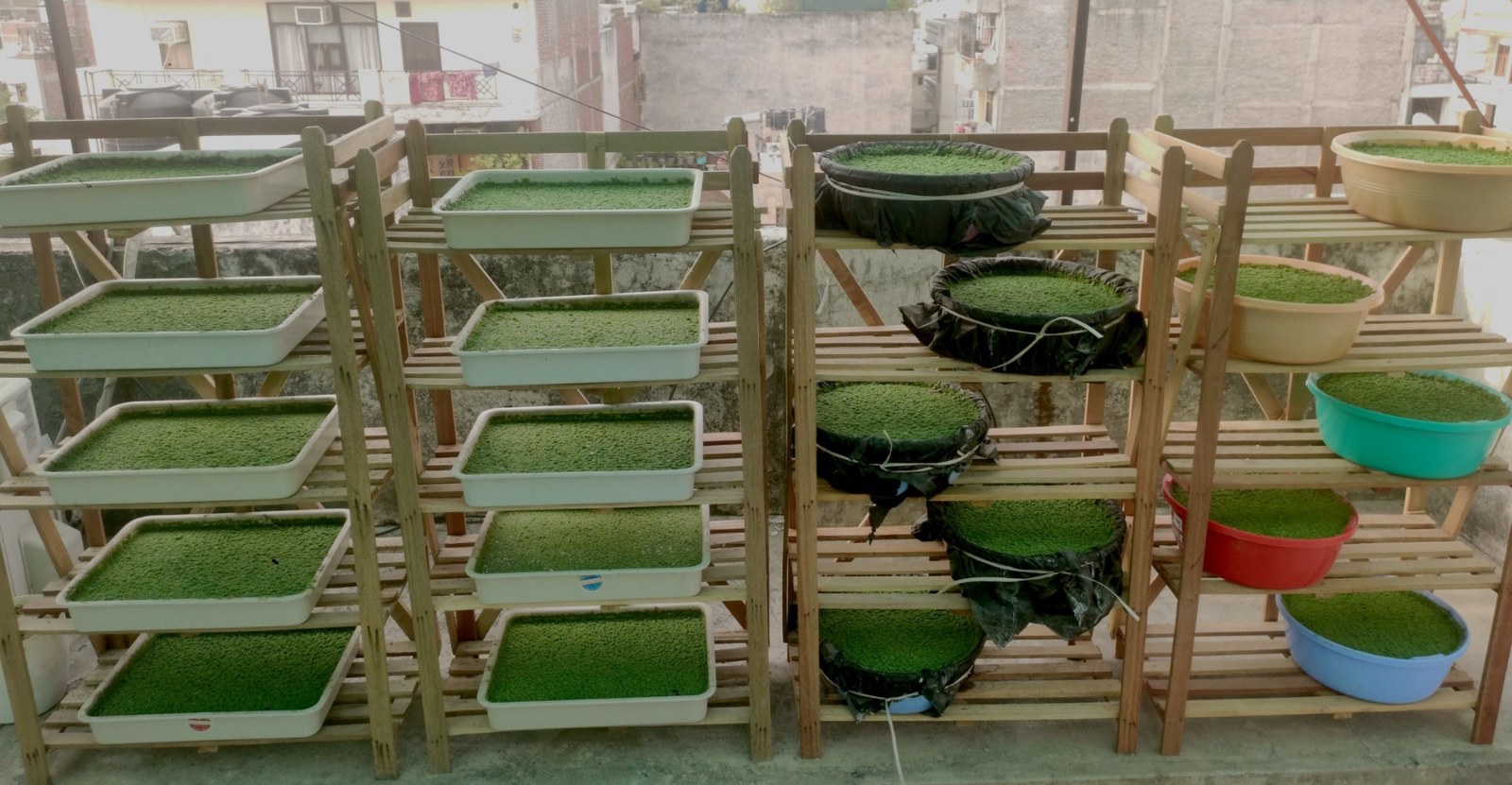
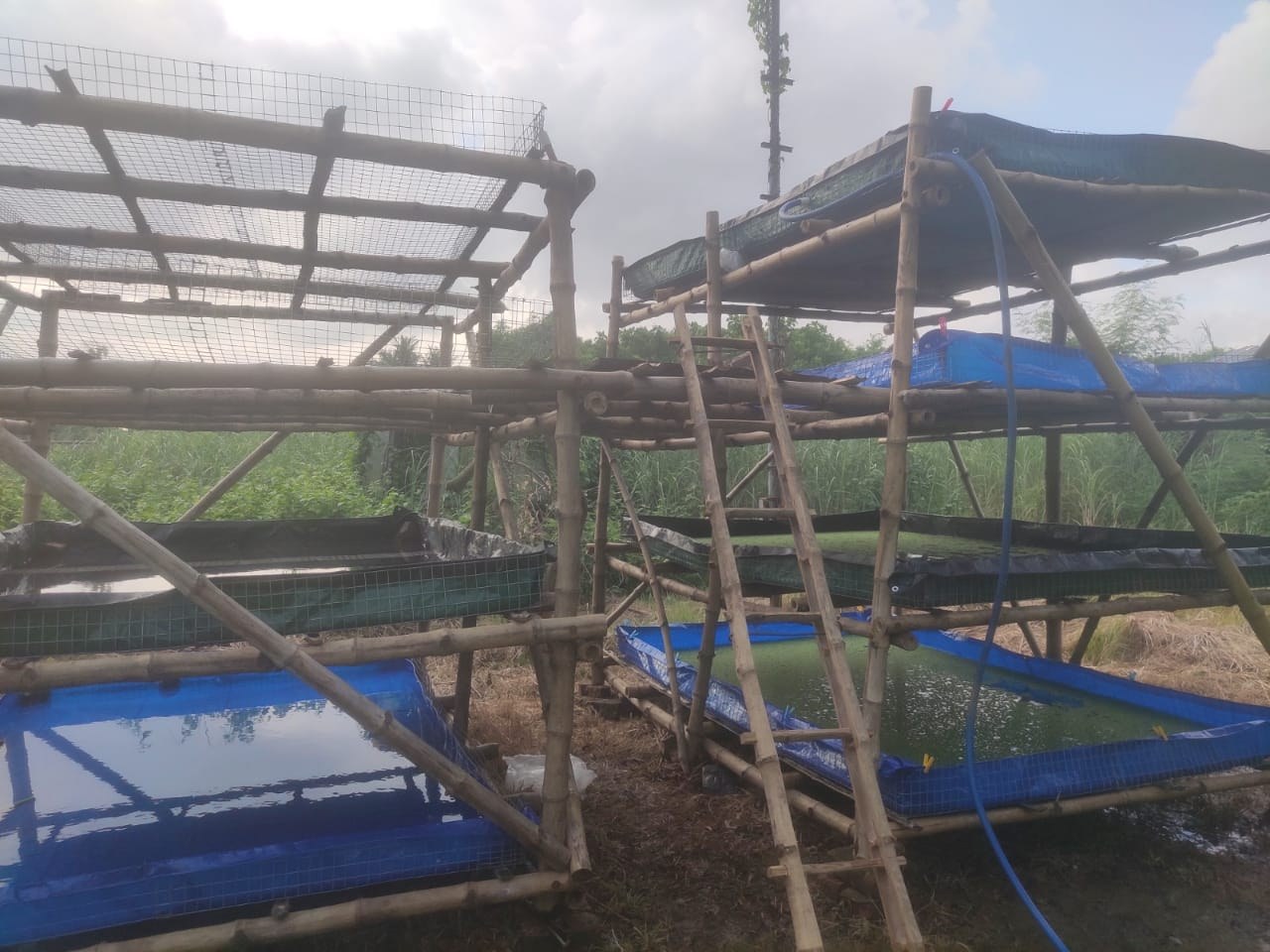
A physical cultivation prototype let us observe the organism, the water surface, the growth cycle and the operating realities that a larger system would have to manage.

REAL PROTOTYPE PHOTOGRAPHY · DOCUMENTARY EVIDENCE
08 · Does it actually work?
Build 02 → Build 03 · documentary evidence

We built the biology before the architecture.

The idea did not begin as a tower. It became one by answering a sequence of physical questions.

01 · Biology

Could Azolla be cultivated predictably?

Tray experiments · establish living behaviour.

02 · Geometry

Could productive surface be stacked?

Early vertical racks · turn area into height.

03 · System

Could four working levels become one operating system?

Bamboo prototype · circulation, shade and access become engineering.

04 · Research apparatus

Could five levels become repeatable infrastructure?

TERI prototype · steel, pools, access, circulation and control.

Real prototype photography · documentary evidence
Prototype evolution
Real photography
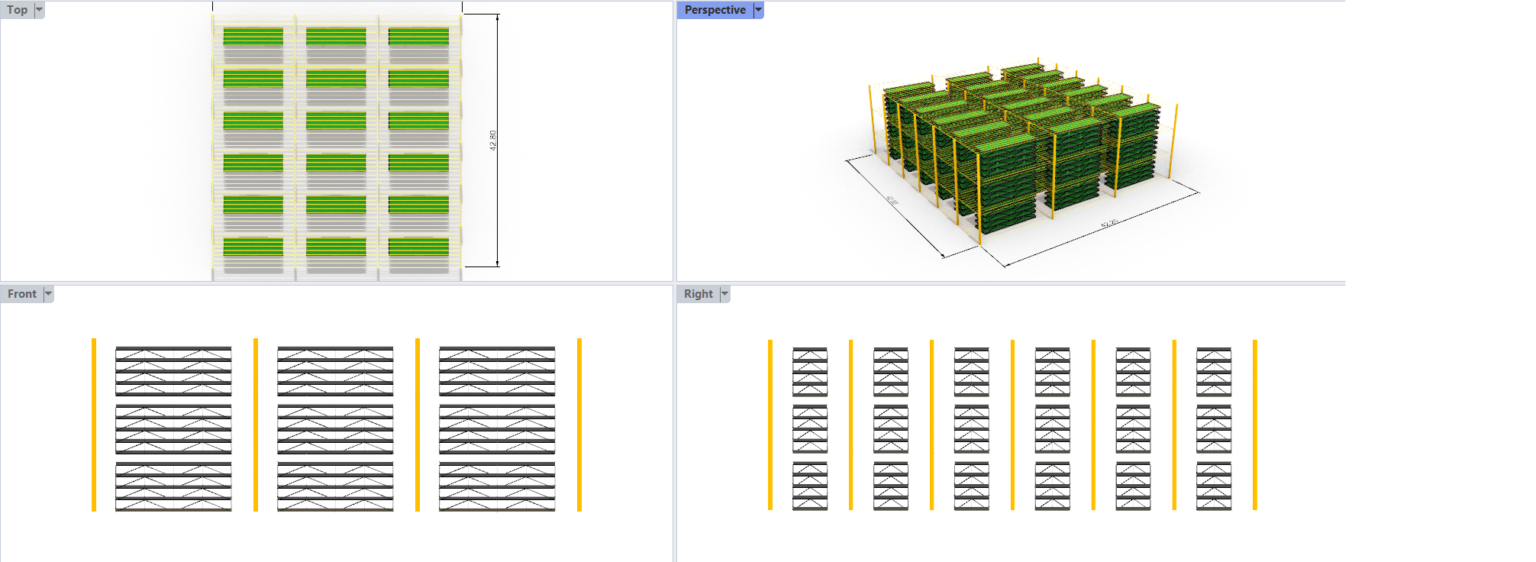
From prototype to optimisation · vertical scalability engineering

A prototype can show that a system exists.

Engineering asks the next question: can geometry, access, density and productive surface be resolved into a structure that can actually be repeated?

Existence is only the beginning.

Climate analysis · operating envelope

Then the system has to survive climate.

Seasonal temperature and environmental data define when, where and how a biological capture system can operate — before deployment is treated as a scaling exercise.

Optimisation begins with the world outside the prototype.

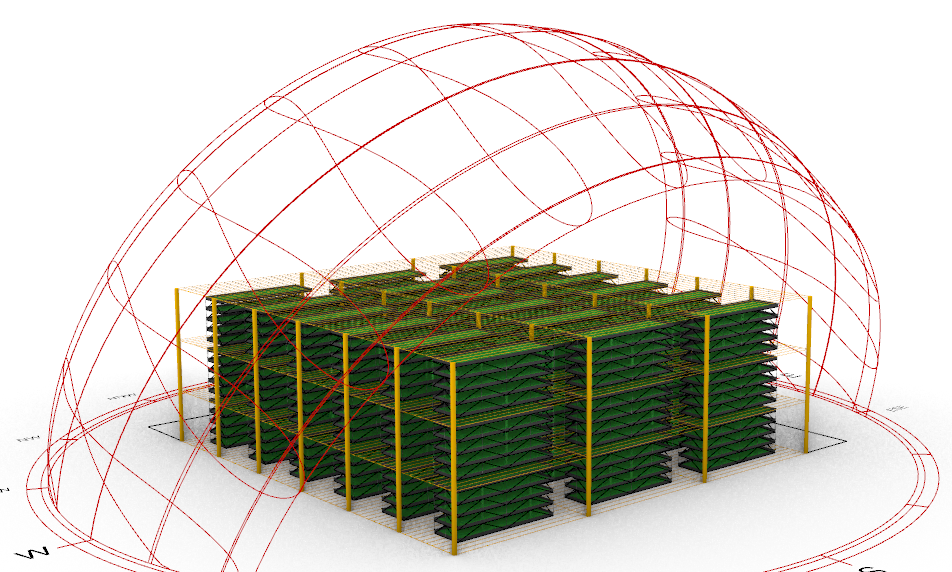
Solar path · biological geometry

And every level still has to receive light.

Solar-path analysis tests orientation, spacing and shading so that vertical area remains biologically productive rather than merely architecturally impressive.

That requires measurement.

Structure
Climate
Solar exposure
System response
09 / The discipline behind the possibility

Hope has to survive
measurement.

Optimism birthed the idea.
Engineered pragmatism must carry it forward.

Monitoring · Reporting · Verification
Measure
Harvest-level records
Account
Traceable carbon quantities
Verify
Evidence open to scrutiny

From growing conditions to fresh harvest and carbon accounting: a protocol designed to make each claim traceable to its supporting record.

A living process.
An inspectable chain of evidence.
Published PCT application
↗

WO2024241342 A1

A SYSTEM FOR ENABLING ARTIFICIAL CULTIVATION OF AZOLLA AND A METHOD THEREOF

Priority claimed · 19 May 2023
PCT/IN2024/050585

Figure / solar geometry
Conceptual wireframe · not a patent drawing

Technical disclosure.
Not certification of carbon performance.

Engineering studies shown separately from the patent record. Publication does not imply patent grant, independent MRV validation or WIPO endorsement.

10 / Traceability before tradability

Trust should be
engineered, too.

Every harvest leaves a record.
Every carbon claim should lead back to one.
HARVEST → CAPTURE → CUMULATIVE
LOGGED QUANTITIES
Fresh biomass harvest
Captured CO₂
Cumulative capture
Aligned harvest records · illustrative quantities
A DISTRIBUTED OBSERVATORY
CONCEPT
Local records. Shared accountability.
Halos illustrate drawdown; they are not atmospheric dispersion predictions.
From a harvest to a history.
COLLECT → LOG → RECONCILE → INSPECT
RECORDS ACCUMULATING
Reporting behind the introduction / methodology note

Headlines are paraphrases, not quotations. Reporting includes investigations, market analysis and regulatory action; these are not interchangeable findings of fraud. The CFTC item describes charges as announced on the date shown.

Illustrative model supplied by the project: logged captured CO₂ = fresh biomass harvest × 0.1; cumulative capture = the running sum of logged capture. The conversion is a project assumption, not an independent validation. The two logged-quantity traces use matching normalised profiles with a fixed visual offset. Capture accounting does not itself establish durable net removal.

WHEN CONFIDENCE BECOMES THE MISSING INFRASTRUCTURE

Rainforest credit claims challenged by investigation

The Guardian / 18 January 2023
REPORTING PARAPHRASE

Popular offset projects face questions over climate benefits

The Guardian / 19 September 2023
REPORTING PARAPHRASE

Regulator brings carbon-credit fraud charges

CFTC / 2 October 2024
REPORTING PARAPHRASE

Carbon-market value falls amid a crisis of confidence

The Guardian / 31 May 2024
REPORTING PARAPHRASE
THE QUESTION IS NO LONGER WHETHER TO ASK FOR EVIDENCE.

A market for carbon.
A deficit of trust.

SCROLL TO A DIFFERENT STANDARD OF EVIDENCE
11 · ONE PURPOSE. MANY CONSEQUENCES.
THE WIDER POSSIBILITY
Carbon capture is the purpose.
Everything else is a dividend.
The AzoNian Process is living infrastructure. Carbon is the primary account — but water, air, heat, soil, biomass, biodiversity and public space all move with the system.
A Climate Tower arrives with one planetary objective and a constellation of local dividends.
PRIMARY PURPOSE
Atmospheric
carbon capture
living infrastructure
01
Cleaner air
AQI impact
02
Water restoration
Wastewater remediation
03
Cooler microclimate
Urban Heat Island Effect mitigation
04
Living soils
Land reclamation and de-desertification
05
Fertiliser displacement
Synthetic fertiliser substitution
06
Circular biomass
Circular economy
07
Biodiversity
Pollinator biodiversity hotspot
08
Greener landscapes
Biomass equalisation
Useful consequences matter.
But the climate problem is still measured in gigatonnes.
12 / The biological multiplier

A gigatonne is not
a laboratory
problem.

It is the challenge of repeating what works.
And here, the capture medium is alive.

Each established installation can grow starter biomass for the next. The capacity to begin again travels with the harvest.

CULTIVATE
HARVEST
PROPAGATE
Replication / each beginning can create another

The next tower begins
inside the last.

Starter biomass moves outward. New installations establish themselves.
Then they, too, become sources for the next generation.

13 / The Eocene Network

One tower is
infrastructure.
Many become
a system.

Distributed across places.
Connected by evidence.
Working towards a shared atmospheric purpose.

A planetary thermostat.
A living network. A capability worth passing on.
Observe · measure · learn · respond
CONCEPTUAL NETWORK / ILLUSTRATIVE LOCATIONS / SHARED RECORDS, NOT PHYSICAL PIPELINES
Earth has witnessed five mass extinction events.

Earth remembers extinction.

ILLUSTRATIVE RECONSTRUCTIONS / NOT TO SCALE

Late Ordovician

Ice advances. Habitats retreat. Ocean systems unravel.

~444 million years ago
Ordovician ice

Continental-scale glaciation drew sea levels down and disrupted shallow marine habitats. Marine life faced a profound ecological crisis.

Devonian seas

Repeated crises affected marine ecosystems. Widespread low-oxygen conditions and nutrient-driven blooms are among the processes investigated.

The Great Dying

Siberian volcanism released greenhouse gases over an extended interval, reshaping climate and ocean chemistry during Earth’s most severe extinction.

Pangaea fractures

Rifting of Pangaea coincided with vast volcanic activity in the region that became the Atlantic. Rapid environmental change accompanied the extinction.

The impact

A large asteroid struck near present-day Yucatán. The impact set off a global environmental shock and ended the age of non-avian dinosaurs.

Now
THE PRESENT / A COMPRESSED PLANETARY PORTRAIT
7 of 9
planetary boundaries breached

Planetary Health Check 2026 ↗

≈1.3°C long-term warming

WMO estimate assessed in 2024, relative to 1850–1900. Not an annual temperature anomaly.

WMO · 10 January 2025 ↗

Make the Anthropocene count.
BUSINESS AS USUAL

More loss.
Less room to return.

Escalating pressure on a living planet. An extinction risk we cannot afford to normalise.

DELIBERATE COURSE CORRECTION

A future we
choose to protect.

Emissions cuts. Ecosystem recovery. Accountable carbon removal.

Let what the Eocene taught us guide the Anthropocene towards Holocene-like stability.
HISTORY IS UNFOLDING / STAY A MOMENT

Earth remembers extinction.

Late Ordovician

~444 million years ago · Ice advances. Habitats retreat. Ocean systems unravel.

Late Devonian

~372–359 million years ago · Oxygen-poor seas. Ecological disruption across successive crises.

Permian–Triassic

~252 million years ago · Vast volcanic provinces. Carbon shocks. The Great Dying.

Triassic–Jurassic

~201 million years ago · Continental rifting and immense eruptions transform a connected world.

Cretaceous–Palaeogene

~66 million years ago · An impact. A global shock. Darkness after the fire.

Now: the branch ahead

Seven of nine planetary boundaries breached — Planetary Health Check 2026. Approximately 1.3°C long-term warming assessed in 2024 — WMO, January 2025.

Business as usual

Escalating ecological pressure and irreversible loss.

A deliberate course correction

Emissions cuts, ecosystem recovery and accountable removal. History need not have the last word.

THE CLIMATE CLOCK
The past showed that biology can move the climate.

Maybe this is how the climate clock turns back.

Not by accident. By design.
THE FIRST DELIBERATE BRANCH

History need not
have the last word.

The past was not a choice. What we build next can be.

THE CLIMATE CLOCK
The past showed that biology can move the climate.

Maybe this is how the climate clock turns back.

Not by accident. By design.
Water
Neer
Forest
Vana
What the water began, the forest carries forward.